
Pourquoi on l’a choisi
Skelethon est l’album où Aesop Rock prend enfin tout en main : c’est son premier disque entièrement autoproduit, et son premier album solo chez Rhymesayers après cinq ans de silence depuis None Shall Pass. Le titre, contraction de « skeleton » et « telethon », annonce un disque dense et hanté par les deuils, porté par des morceaux comme Zero Dark Thirty ou Ruby ’81. En vinyle, avec la pochette du peintre Aryz, c’est une pièce centrale pour toute collection de rap indépendant.
Ce qu’il y a dans la boîte
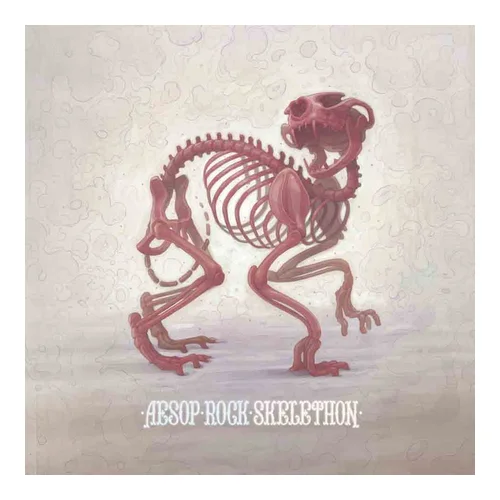
Sixième album studio d’Aesop Rock, Skelethon est sorti le 10 juillet 2012 chez Rhymesayers Entertainment. Le pressage d’origine se présente en double vinyle rouge translucide, dans une pochette gatefold imprimée en couleur, avec un poster recto verso de 12 x 24 pouces, un panneau de notes de 12 x 12 pouces et une carte de téléchargement. La pochette est signée Aryz, peintre basé à Barcelone. L’album compte 15 titres et accueille notamment Kimya Dawson, Allyson Baker de Dirty Ghosts, Hanni El Khatib et Rob Sonic.
Pour qui ?
Le fan de longue date d’Aesop Rock y trouvera un tournant de sa discographie : premier album entièrement produit de sa main, où ses instrumentaux, entre pianos poussiéreux, guitares saturées et synthés psychédéliques, prennent autant de place que son écriture. Le collectionneur de vinyles rap appréciera un objet soigné, gatefold et poster compris, avec plusieurs pressages à comparer. Enfin, l’amateur d’art urbain y verra un pont avec le street art, puisque la pochette est l’œuvre d’Aryz, muraliste reconnu. Il parlera moins à qui découvre le rap : l’écriture d’Aesop Rock est réputée pour sa densité et son vocabulaire foisonnant, qui demandent plusieurs écoutes.
À savoir avant d’acheter
Plusieurs pressages coexistent. L’original de 2012 et la réédition de 2020 sont tous deux en double vinyle rouge ; ils se distinguent par les gravures de la matrice et par le papier de l’insert des paroles, lisse sur la réédition et légèrement texturé sur l’original. L’édition 10 ans est un triple vinyle distinct : deux disques marbrés crème et noir, un troisième disque transparent, gravé sur une seule face et imprimé aux UV, avec quatre titres bonus exclusifs, une pochette gatefold à la mise en page revue et un insert quatre volets avec les paroles. L’album existe aussi en CD, en digipak avec un poster de 16 panneaux. Côté marché, la réédition anniversaire se trouve plus facilement neuve que le pressage d’origine, plus recherché en occasion.
À associer avec
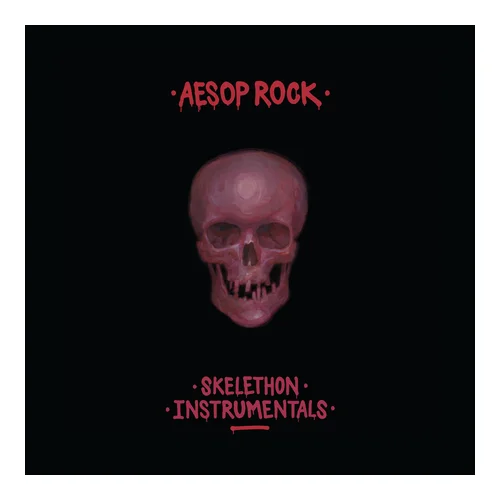
Skelethon Instrumentals, pressé en vinyle pour la première fois à l’occasion des 10 ans de l’album, permet d’écouter les productions d’Aesop Rock pour elles-mêmes. None Shall Pass, l’album précédent sorti en 2007, montre d’où il vient. The Impossible Kid, sorti chez Rhymesayers en 2016, poursuit sa trajectoire d’auteur-producteur solo.
Why we picked it
Skelethon is the album where Aesop Rock finally takes full control: his first entirely self-produced record, and his first solo album on Rhymesayers after five years of silence since None Shall Pass. The title, a mash-up of “skeleton” and “telethon,” sets the tone for a dense record haunted by loss, carried by tracks like Zero Dark Thirty and Ruby ’81. On vinyl, with cover art by painter Aryz, it’s a cornerstone of any independent rap collection.
What’s in the box
Aesop Rock’s sixth studio album, Skelethon, was released on July 10, 2012, on Rhymesayers Entertainment. The original pressing is a translucent red double LP in a full-colour gatefold jacket, with a 12×24-inch double-sided poster, a 12×12-inch liner notes panel and a download card. The cover art is by Aryz, a Barcelona-based painter. The album runs 15 tracks and features guests including Kimya Dawson, Allyson Baker of Dirty Ghosts, Hanni El Khatib and Rob Sonic.
Who is it for?
Longtime Aesop Rock fans get a turning point in his catalogue: his first album produced entirely by his own hand, where his beats, built from dusty pianos, distorted guitars and psychedelic synths, carry as much weight as his writing. Rap vinyl collectors will appreciate a carefully made object, gatefold and poster included, with several pressings to compare. Finally, urban art enthusiasts will find a bridge to street art, since the cover is the work of Aryz, an acclaimed muralist. It will speak less to newcomers to rap: Aesop Rock’s writing is known for its density and sprawling vocabulary, which reward repeated listens.
Know before you buy
Several pressings exist. The 2012 original and the 2020 reissue are both red double LPs; they differ in their runout etchings and in the paper of the lyric insert, smooth on the reissue and slightly textured on the original. The 10th anniversary edition is a separate triple LP: two cream and black marbled discs, plus a single-sided, UV-printed ultra-clear third disc with four exclusive bonus tracks, a gatefold jacket with revised art layouts and a four-panel lyric insert. The album is also available on CD, in a digipak with a 16-panel poster. On the market, the anniversary reissue is easier to find new than the original pressing, which is more sought after secondhand.
Pairs well with
Skelethon Instrumentals, pressed on vinyl for the first time for the album’s 10th anniversary, lets you hear Aesop Rock’s production on its own terms. None Shall Pass, the previous album released in 2007, shows where he came from. The Impossible Kid, released on Rhymesayers in 2016, continues his path as a solo writer-producer.